Oystermen
Mariners' Museum, Uncurated Search Results
Type: Schooner
Year: 1889
Builder: Kirby & Lang
Location: St. Michaels

These records are found in the online catalog of The Mariners’ Museum and Park in Newport News, Virginia. Uncurated search results are presented to give researchers and interested readers an idea of whether the museum’s archives contain information about this vessel and whether it may be worthwhile to visit the museum’s catalog search page for further investigation. Uncurated results may be inaccurate or incomplete.
Search mode: Exact Name. Search phrase(s): "Oystermen". Results returned: 20. Results displayed in this table: 20.
Use these buttons to send uncurated search results to your own app or text document for further research. First, check the box for any row, or click "Select All" then uncheck any rows. Then click "Show Selections". You can then copy your selections from the text box and past them into your app.
| Fetch? | Row ID | Media | Date | Vessel | Place | Related Places | Inscription/Marks | Subject | Notes | Archive Number |
|---|---|---|---|---|---|---|---|---|---|---|
| 1 | No image URL. | Fishers–Chesapeake Bay (Md. and Va.).; Oyster fisheries–Chesapeake Bay (Md. and Va.).; Skipjacks. | Issued in a case. | LB18261 | ||||||
| 2 | No image URL. | Oyster fisheries–Chesapeake Bay (Md. and Va.). | Black oystermen of the Bay country. | LB77206 | ||||||
| 3 | No image URL. | African Americans–Chesapeake Bay Region (Md. and Va.). | Black oystermen of the Bay country. | LB42620 | ||||||
| 4 | No image URL. | Saint Michaels (Md.). | Black oystermen of the Bay country. | LB55352 | ||||||
| 5 | No image URL. | Saint Mary's County (Md.). | Oyster fisheries–Maryland. | Rakes, nipper and tongs : __oystermen in antebellum St. Mary's County. | LB77212 | |||||
| 6 | No image URL. | Dugout canoes–Virginia | Dugout log canoes : __oystermen around the Chesapeake still use a modern version of the Bay's earliest vessel | LB103798 | ||||||
| 7 | 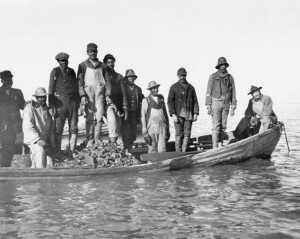 | ca1905 | York River (Va.). | Oystering–Chesapeake Bay (Md. and Va.). | Ten men pose for a photograph in a rowboat which is loaded with oysters. | P0001.001/01-#P2849 | ||||
| 8 | 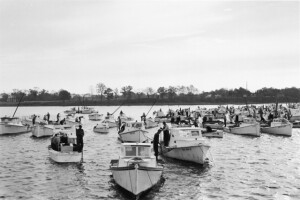 | 1970 | Wicomico River (Wicomico County and Somerset County, Md.). | Oyster culture–Chesapeake Bay (Md. and Va.) | Bow view of multiple fishing vessels, ready to harvest. | P0001.001/01-#P4027 | ||||
| 9 | 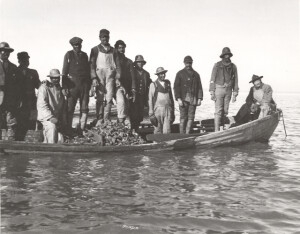 | ca1905 | York River (Va.). | Oystering–Chesapeake Bay (Md. and Va.). | Ten men pose for a photograph in a rowboat which is loaded with oysters. | P0001.001/01-#P2551 | ||||
| 10 | 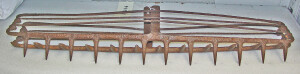 | SHORT DESCRIPTION: Metal set of oyster tongs without wooden shaft. NOTES: "Around 1700, shaft tongs, which allowed oystermen to stand in a boat and pluck the oysters from the bottom, were introduced on the Bay. The shafts and heads were originally made from wood. Later, the heads were formed from metal, but even today the shafts are made from wood in the traditional way. Early hand tongers in Virginia were either slaves, who were harvesting oyster for their masters, or a poorer class of whites who ere trying to scrape together enough to eat. However, all this changed in 1865 when the Civil War ended. The economy of the South had been devastated by the war, and many people had to turn to the river just to survive. An 1880's U.S. fish report by Richard H. Edmonds on the oyster interests of Virginia states: 'Previous to the late war the oystermen of Virginia were composed of Negroes working for their masters and of a very rough class of whites. But at the close of the war, the demand for oysters was very great and high prices were paid. Many who had been reduced from wealth to poverty were glad to avail themselves of the chance to make a support by oystering, which was at the time a very profitable employment. The four years of war, during which oysters had almost a complete rest in many parts of the stare, gave them a chance for development, and when the trade revived the beds were well stocked with large, finely-flavored oysters. Man from nearly all occupations, representing all classes of society eagerly entered the business, and soon there were hundreds of oystermen where formerly there had been but a dozen or so. Many of the most extensive farmers in the tidewater counties found that the conditions of labor had so greatly changed that to make a living it was necessary for them to devote all spare time to the oyster trade. A very noticeable fact in connection with the tonging interest of Virginia is the total absence of foreigners in the trade. Among the 8,860 tongers of Virginia (in the 1880's) there are, according to the statements of the county clerks, only about ten who are not Americans. The entire trade may be said to be virtually in the hands of native Virginians, since there are probably not 300 tongers in the whole State who were not born and raised there. The life of an ordinary tonger presents few attractions to induce strangers to enter this business. The work is very laborious, the remuneration only fair, and the injury to health from exposure is so great that few ever reach old age.' Hand tongs were made up and down the Bay and almost every waterfront community had a good supply of tongs available for sale. The local blacksmith would make the heads and a shaft maker would shape the wooden scissor-like shafts from either hickory or locust. The length of the shafts depended greatly on the rivers and creeks that the oystermen were working. There was also a short-handle tong with a small head used in shallow water that was called nipper. These were more for home use in creeks and often children were sent out with a pair of nippers to catch mess of oysters for the supper table. The long-handle tongs ranged from fourteen feet to around thirty feet in length and are still used today in Maryland and Virginia waters." (Chowning, Larry S. HARVESTING THE CHESAPEAKE: TOOLS AND TRADITIONS. Centreville, Maryland: Tidewater Publishers. p. 87-88.) LABEL COPY: Oyster Tongs The Mariners' Museum NOTES: 12 teeth (Waters of Despair, September 15, 2000; see Exhibit file for additional information) ADDITIONAL INFORMATION: See "Harvesting the Chesapeake: Tools and Traditions" by Larry S. Chowning located in the object file. | CL27781 | |||||||
| 11 | 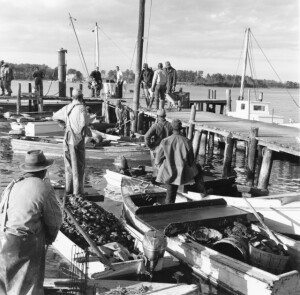 | WRITTEN ON VERS0: TONGERS RETURNING TO SUNNYBANK DOCK. | Oystering–Chesapeake Bay (Md. and Va.).; African Americans. | View looking over several small fishing boats and men with their day's catch toward the pier at Sunny Bank dock, Reedville, Va. | P0001.001/01-#P4026 | |||||
| 12 | 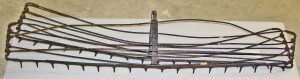 | SHORT DESCRIPTION: Metal set of oyster tongs without wooden shaft. 18 teeth. NOTES: "Around 1700, shaft tongs, which allowed oystermen to stand in a boat and pluck the oysters from the bottom, were introduced on the Bay. The shafts and heads were originally made from wood. Later, the heads were formed from metal, but even today the shafts are made from wood in the traditional way. Early hand tongers in Virginia were either slaves, who were harvesting oyster for their masters, or a poorer class of whites who ere trying to scrape together enough to eat. However, all this changed in 1865 when the Civil War ended. The economy of the South had been devastated by the war, and many people had to turn to the river just to survive. An 1880's U.S. fish report by Richard H. Edmonds on the oyster interests of Virginia states: 'Previous to the late war the oystermen of Virginia were composed of Negroes working for their masters and of a very rough class of whites. But at the close of the war, the demand for oysters was very great and high prices were paid. Many who had been reduced from wealth to poverty were glad to avail themselves of the chance to make a support by oystering, which was at the time a very profitable employment. The four years of war, during which oysters had almost a complete rest in many parts of the stare, gave them a chance for development, and when the trade revived the beds were well stocked with large, finely-flavored oysters. Man from nearly all occupations, representing all classes of society eagerly entered the business, and soon there were hundreds of oystermen where formerly there had been but a dozen or so. Many of the most extensive farmers in the tidewater counties found that the conditions of labor had so greatly changed that to make a living it was necessary for them to devote all spare time tot he oyster trade. A very noticeable fact in connection with the tonging interest of Virginia is the total absence of foreigners in the trade. Among the 8,860 tongers of Virginia (in the 1880's) there are, according to the statements of the county clerks, only about ten who are not Americans. The entire trade may be said to be virtually in the hands of native Virginians, since there are probably not 300 tongers in the whole State who were not born and raised there. The life of an ordinary tonger presents few attractions to induce strangers to enter this business. The work is very laborious, the remuneration only fair, and the injury to health from exposure is so great that few ever reach old age.' Hand tongs were made up and down the Bay and almost every waterfront community had a good supply of tongs available for sale. The local blacksmith would make the heads and a shaft maker would shape the wooden scissor-like shafts from either hickory or locust. The length of the shafts depended greatly on the rivers and creeks that the oystermen were working. There was also a short-handle tong with a small head used in shallow water that was called nipper. These were more for home use in creeks and often children were sent out with a pair of nippers to catch mess of oysters for the supper table. The long-handle tongs ranged from fourteen feet to around thirty feet in length and are still used today in Maryland and Virginia waters." (Chowning, Larry S. HARVESTING THE CHESAPEAKE: TOOLS AND TRADITIONS. Centreville, Maryland: Tidewater Publishers. p. 87-88.) | CL27782 | |||||||
| 13 | 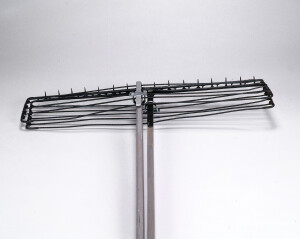  | SHORT DESCRIPTION: Metal set of oyster tongs with reproduction wooden shaft. 16 teeth. NOTES: "Around 1700, shaft tongs, which allowed oystermen to stand in a boat and pluck the oysters from the bottom, were introduced on the Bay. The shafts and heads were originally made from wood. Later, the heads were formed from metal, but even today the shafts are made from wood in the traditional way. Early hand tongers in Virginia were either slaves, who were harvesting oyster for their masters, or a poorer class of whites who were trying to scrape together enough to eat. However, all this changed in 1865 when the Civil War ended. The economy of the South had been devastated by the war, and many people had to turn to the river just to survive. An 1880's U.S. fish report by Richard H. Edmonds on the oyster interests of Virginia states: 'Previous to the late war the oystermen of Virginia were composed of Negroes working for their masters and of a very rough class of whites. But at the close of the war, the demand for oysters was very great and high prices were paid. Many who had been reduced from wealth to poverty were glad to avail themselves of the chance to make a support by oystering, which was at the time a very profitable employment. The four years of war, during which oysters had almost a complete rest in many parts of the state, gave them a chance for development, and when the trade revived the beds were well stocked with large, finely flavored oysters. Men from nearly all occupations, representing all classes of society eagerly entered the business, and soon there were hundreds of oystermen where formerly there had been but a dozen or so. Many of the most extensive farmers in the tidewater counties found that the conditions of labor had so greatly changed that to make a living it was necessary for them to devote all spare time to the oyster trade. A very noticeable fact in connection with the tonging interest of Virginia is the total absence of foreigners in the trade. Among the 8,860 tongers of Virginia (in the 1880's) there are, according to the statements of the county clerks, only about ten who are not Americans. The entire trade may be said to be virtually in the hands of native Virginians, since there are probably not 300 tongers in the whole State who were not born and raised there. The life of an ordinary tonger presents few attractions to induce strangers to enter this business. The work is very laborious, the remuneration only fair, and the injury to health from exposure is so great that few ever reach old age.' Hand tongs were made up and down the Bay and almost every waterfront community had a good supply of tongs available for sale. The local blacksmith would make the heads and a shaft maker would shape the wooden scissor-like shafts from either hickory or locust. The length of the shafts depended greatly on the rivers and creeks that the oystermen were working. There was also a short-handle tong with a small head used in shallow water that was called nipper. These were more for home use in creeks and often children were sent out with a pair of nippers to catch mess of oysters for the supper table. The long-handle tongs ranged from fourteen feet to around thirty feet in length and are still used today in Maryland and Virginia waters." (Chowning, Larry S. HARVESTING THE CHESAPEAKE: TOOLS AND TRADITIONS. Centreville, Maryland: Tidewater Publishers. p. 87-88.) | CL27783 | |||||||
| 14 | 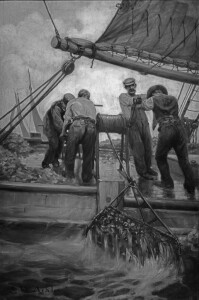 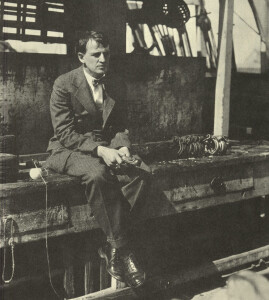 | SHORT DESCRIPTION: Oil painting by Clifford W. Ashley titled "The Dredge Comes Up from the Deep like a Mining Cage of Steel". The image shows four men busily cranking the handles of a reel attached to an oyster dredge, which is shown emerging from the water at the vessels starboard side loaded with oysters. The deck of the schooner at the left and behind the men is covered with heaps of oysters. Over the men's heads, is the boom of the mainsail and the large block of the mainsheet holding the boom in place. The sail appears to have a reef at its foot. Another schooner is visible behind the vessel at the left. The painting was created to illustrate an article titled "In the Name of the Oyster" which was published in Harper's Monthly Magazine Vol. 117, October 1908. In the article it was given the caption "The Dredge Comes Up from the Deep like a Mining Cage of Steel." The article is a description of the oyster business and oystermen of Delaware Bay. This painting is the mate of QO 169 so it's probable that the schooner depicted is also the Mattie Flavell. NOTES: According to the 'Whalers, Wharves and Waterways' catalog in the fall of 1901 Ashley went to Wilmington, Delaware to study with artist Howard Pyle who had opened an art school. To provide financial assistance to his students, Pyle secured commissions for them to create illustrations for various books and periodicals. Ashley provided images (frontispieces) for books devoted to poets James Russel Lowell, Oliver Wendell Holmes and William Wordsworth. Between 1902 and 1904 he supplied drawings to illustrate articles that appeared in Delineator, Leslies, McClure's and Success. In 1904 Ashley was commissioned by Harper's Monthly Magazine to write and illustrate an article on whaling. His articles appeared in 1906 under the title "The Blubber Hunters." In the winters of 1904 to 1908 Ashley spent his time in the studio Pyle had built for his students at 1616 North Rodney Street in Wilmington. During this time, a number of magazines published paintings by Ashley including Century Magazine, Harper's Monthly Magazine, Scribner's and the Saturday Evening Post. Ashley also produced the two paintings documenting the oystering industry in Wilmington, Delaware for Philip V. Mighels article "In the Name of the Oyster" which was published in 1908. This is how the location for the production of these paintings was provided. NOTES: The article in Harper's Monthly Magazine describes the oyster business and oystermen of Delaware Bay. Excerpts: Oystering is divided into two separate seasons and the crews employed in the work are utterly different. The seasons are planting and harvesting. After April very few oysters are harvested, but millions are planted for the future. Planting season, which occupies the boats once the harvesting season has come to an end, involves the systematic planting of the young, unmarketable oysters, which requires no technical skill. This labor is therefore assigned to any makeshift crew the captain may enlist. The regular oystermen, skilled artisans of their trade, depart in the summer and do not return until autumn. In the past there was no such thing as oyster planting. Men just went out upon the natural beds of oysters and harvested whatever they could from a skiff with long hand tongs, on a larger boat by dragging dredges across the bottom that six crew would haul in with a crank and reel and pure muscle or by hauling the dredges up with gasoline engines. This unfettered gathering of oysters was threatening the extermination of the bivalve so protective regulations were enacted. Oystermen nowadays are farmers of the deep. They own their artificial beds and seed them down and cultivate them carefully, and watch their crops and scarecrow off the predatory hordes, both men and fish. An oyster bed such as this may compromise anywhere from fifty to three-hundred acres, preferably of good clean sand or broken rock and shell, and devoid at the start of all natural growth of oysters. Oysters spawn during the first warm months of coming summer. The spawn attaches itself like millions of freckles to anything affording a foothold—anything sharp, like broken shells, old bottles, other oysters, and rocks. These freckles grow rapidly into “spats,” small fingernail sized oysters. The oysters quickly grow with overcrowding causing them to grind against each other forcing some off their foothold. The baby oysters are harvested by oystermen, who pitch back into the water tons and tons of rock or broken shell which creates a new foothold for future oysters. The baby oysters are carried to the oystermen’s staked out farms and scattered like seeds. The private oyster beds are divided from each other and subdivided into many smaller fields to facilitate the work. This is necessary because the oysters must be left to grow for three full seasons before they are large enough to be marketable. Oyster harvesting season begins in September. The men work from dawn till dusk dredging the oysters from their beds as rapidly as the men and machines can haul the dredge up. The dredge comes up from the deep like a mining-cage of steel. It is simply a framework made of iron rods, with a rake upon one edge that plows and a chain net to hold the load of oysters. The dredge is dragged up by a specially constructed chain that the engine winds up on a reel. The oysters are dumped on the deck and the dredge is sent over for another load. In the meantime a crew, wearing rubber stalls on their hands to protect them from scratches and cuts, are busily culling through the heap of oysters. Colonies of six, eight, ten or more oysters cemented together are carefully broken apart with one sharp tap. They are broken up into heaps of “primes” or “cullins.” “Primes” are the larger, finer oysters and “cullins” are smaller, second choice oysters. In port, the oysters are loaded onto specially constructed floats with tanks that allow the oysters to be submerged in the water below the ebb-tide level. There the oysters “drink” and fatten up and freshen. They oysters are left there for three tide changes watched over by oystermen. When ready, the tanks are pumped out, the floats rise, and men in rubber boots shovel the oysters into a waiting scow. The oysters are then swiftly counted into baskets before being transferred into bags, before being rushed to market. Each oyster is handled at least thirteen different times before it reaches the market. NOTES: Clifford Warren Ashley (1881–1947) was an American artist, illustrator, author, sailor, photographer, and knot expert. Born in New Bedford, Massachusetts. He died in Westport Point, Massachusetts in 1947. He attended the Eric Pape Art School in Boston. In the summer of 1901 Ashley, along with friends N.C. Wyeth and Henry J. Peck, studied under George Noyes in Annisquam, Massachusetts. In the fall, he went on to become a student of Howard Pyle's school in Wilmington, Delaware. Ashley was a prolific painter of New England landscapes and whaling scenes but is perhaps best known for The Ashley Book of Knots (1944), an encyclopedic reference manual with directions and descriptions for and illustrations of 3,857 knots. The original manuscript of this publication is in the collection of The Mariners’ Museum. Ashley also wrote The Blubber Hunters (1906), The Yankee Whaler (1926) and The Whaleships of New Bedford (1929). The Museum’s collection holds a number of items donated or acquired from Ashley: [letters and numbers are old accession numbers] FC34 document box; FW1 water thief; IC3 ditty bag; IC4 sea bag; JO1-2 rowlocks; JP22 mariners splice; JR2.01-.02 single blocks; JR3.01-.02 double blocks; JR4 fairlead block; JR5 Jib hank; MH17 model of iceboat Flying Cloud; MH20 model of full rigged pack ship Louisa; MH21 model of tea clipper; MX1 prototype model of catboat; NR1 drawing instrument; NR2-3 parallel rules; NR4 gunter scale; NR5 parallel rule with protractor; OF36 figurehead Martha; OF53 Figurehead mermaid; paintings QO12, QO13, QO114, QO169, QO170, QO183, QO184; TC43 hood driver; TS1 plane; TS3 caulking ladle; TS4 Adze; TS5 scraper; TS6 caulk ripper; TS7 nose auger; Harpoons WH1-22, WH41; WW1 lantern keg; WW2 water bucket; WW3 piggin; YW1 baleen; and YW3 jawbone from small sperm whale. | CL20648 | |||||||
| 15 | 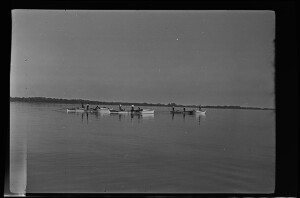 | 10/1941 | Chester River (Md.). | Envelope: "Tongers in Chester R & buy-boats in Swan Cr. 10-13-41 & 10/15/41" | Oystering–Maryland–Chester River.; Skiffs–Maryland–Chester River. | Shows at least nine individuals in several different skiffs tonging for oysters. The shot is made from the shore and is somewhat distant. These oystermen might be African Americans. There is no caption for this negative. | MS0063/01-711#0711-B | |||
| 16 | 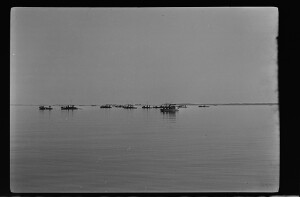 | 10/1941 | Chester River (Md.). | Envelope: "Tongers in Chester R & buy-boats in Swan Cr. 10-13-41 & 10/15/41" | Oystering–Maryland–Chester River.; Skiffs–Maryland–Chester River. | Shows a group of skiffs with oystermen tonging for oysters. The shot is darker and more distant than 0711-B. There is no caption for this negative. | MS0063/01-711#0711-D | |||
| 17 | 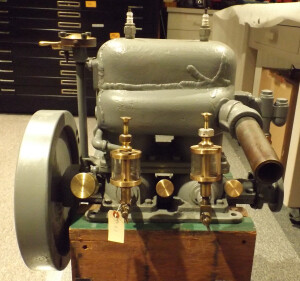 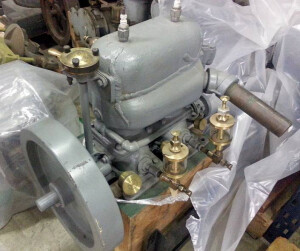 | SHORT DESCRIPTION: High compression, two-cycle engine. RESEARCHER'S NOTES: L. Oglesby...This was probably used commercially by oystermen to get them out to the oyster grounds. It could also have been used in a pleasure boat. | CL6061 | |||||||
| 18 | 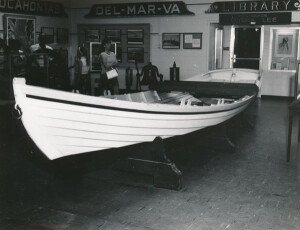 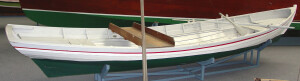 | SHORT DESCRIPTION: Yankee Skiff (or Staten Island Skiff). Built on Staten Island, New York, by unknown builder, circa 1860 of white cedar planks over oak frames. 22'10" lapstrake hull has a plank keel, spoon bow, and wineglass stern. 6'4" beam. NOTES: Boats of this type migrated to Chesapeake Bay on the deck of schooner, oyster beds in the New York area having become depleted. During the winter Northern oysterman came to Chesapeake Bay for oysters. Local oysterman adopted the boat which they found to be durable, seaworthy, maneuverable and easily rowed by one man. This boat is one of a group used by the donor's father on his oyster beds in the York River. VESSEL INFORMATION - BOAT TYPE: YANKEE SKIFF BOAT BUILT: LATE 19TH CENTURY ORGIN: STATEN ISLAND, NEW YORK BOAT DIMENIONS: 22-10-0 (LENGTH OA), 6-4-0 (BEAM) INVENTORY: (2) oars; culling board; -These are items associated with this boat. See component parts supplemental record for additional information. A pair of oyster tongs have been stored inside this boat - 1981.03.03. | CL902 | |||||||
| 19 | 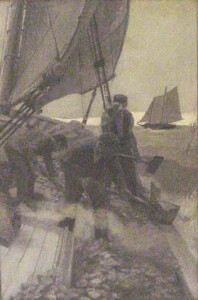 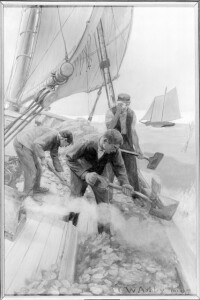 | SHORT DESCRIPTION: Oil painting by Clifford W. Ashley titled "Oystering on the schooner Mattie Flavell". In the image the viewer is standing on the deck of the Mattie Flavell looking towards the bow. The vessel's mainsail and foresail are in the upper right corner. The large block of the mainsheet holds the boom of the mainsail in place. The schooner is healing to starboard and the deck is covered with heaps of oyster shells. Three men are standing amidst the shells and are actively shoveling the shells into the bay. The man closest to the viewer is in the process of heaving the shells overboard, the man bent over behind him is in the process of scooping up more material, and the man in the background is standing, facing the viewer with his shovel in his left hand and his right is wiping his brow with a handkerchief. Another schooner is in the background at the right. A bundle of sticks at the center right may mark the oyster beds. The painting was created to illustrate an article titled "In the Name of the Oyster" which was published in Harper's Monthly Magazine Vol. 117, October 1908. In the article it was given the caption "Millions are planted for the Future." A second painting illustrating the article is also in the Museum's collection (QO 170). NOTES: According to the 'Whalers, Wharves and Waterways' catalog in the fall of 1901 Ashley went to Wilmington, Delaware to study with artist Howard Pyle who had opened an art school. To provide financial assistance to his students, Pyle secured commissions for them to create illustrations for various books and periodicals. Ashley provided images (frontispieces) for books devoted to poets James Russel Lowell, Oliver Wendell Holmes and William Wordsworth. Between 1902 and 1904 he supplied drawings to illustrate articles that appeared in Delineator, Leslies, McClure's and Success. In 1904 Ashley was commissioned by Harper's Monthly Magazine to write and illustrate an article on whaling. His articles appeared in 1906 under the title "The Blubber Hunters." In the winters of 1904 to 1908 Ashley spent his time in the studio Pyle had built for his students at 1616 North Rodney Street in Wilmington. During this time, a number of magazines published paintings by Ashley including Century Magazine, Harper's Monthly Magazine, Scribner's and the Saturday Evening Post. Ashley also produced the two paintings documenting the oystering industry in Wilmington, Delaware for Philip V. Mighels article "In the Name of the Oyster" which was published in 1908. This is how the location for the production of these paintings was provided. NOTES: The article in Harper's Monthly Magazine describes the oyster business and oystermen of Delaware Bay. Excerpts: Oystering is divided into two separate seasons and the crews employed in the work are utterly different. The seasons are planting and harvesting. After April very few oysters are harvested, but millions are planted for the future. Planting season, which occupies the boats once the harvesting season has come to an end, involves the systematic planting of the young, unmarketable oysters, which requires no technical skill. This labor is therefore assigned to any makeshift crew the captain may enlist. The regular oystermen, skilled artisans of their trade, depart in the summer and do not return until autumn. In the past there was no such thing as oyster planting. Men just went out upon the natural beds of oysters and harvested whatever they could from a skiff with long hand tongs, on a larger boat by dragging dredges across the bottom that six crew would haul in with a crank and reel and pure muscle or by hauling the dredges up with gasoline engines. This unfettered gathering of oysters was threatening the extermination of the bivalve so protective regulations were enacted. Oystermen nowadays are farmers of the deep. They own their artificial beds and seed them down and cultivate them carefully, and watch their crops and scarecrow off the predatory hordes, both men and fish. An oyster bed such as this may compromise anywhere from fifty to three-hundred acres, preferably of good clean sand or broken rock and shell, and devoid at the start of all natural growth of oysters. Oysters spawn during the first warm months of coming summer. The spawn attaches itself like millions of freckles to anything affording a foothold—anything sharp, like broken shells, old bottles, other oysters, and rocks. These freckles grow rapidly into “spats,” small fingernail sized oysters. The oysters quickly grow with overcrowding causing them to grind against each other forcing some off their foothold. The baby oysters are harvested by oystermen, who pitch back into the water tons and tons of rock or broken shell which creates a new foothold for future oysters. The baby oysters are carried to the oystermen’s staked out farms and scattered like seeds. The private oyster beds are divided from each other and subdivided into many smaller fields to facilitate the work. This is necessary because the oysters must be left to grow for three full seasons before they are large enough to be marketable. Oyster harvesting season begins in September. The men work from dawn till dusk dredging the oysters from their beds as rapidly as the men and machines can haul the dredge up. The dredge comes up from the deep like a mining-cage of steel. It is simply a framework made of iron rods, with a rake upon one edge that plows and a chain net to hold the load of oysters. The dredge is dragged up by a specially constructed chain that the engine winds up on a reel. The oysters are dumped on the deck and the dredge is sent over for another load. In the meantime a crew, wearing rubber stalls on their hands to protect them from scratches and cuts, are busily culling through the heap of oysters. Colonies of six, eight, ten or more oysters cemented together are carefully broken apart with one sharp tap. They are broken up into heaps of “primes” or “cullins.” “Primes” are the larger, finer oysters and “cullins” are smaller, second choice oysters. In port, the oysters are loaded onto specially constructed floats with tanks that allow the oysters to be submerged in the water below the ebb-tide level. There the oysters “drink” and fatten up and freshen. They oysters are left there for three tide changes watched over by oystermen. When ready, the tanks are pumped out, the floats rise, and men in rubber boots shovel the oysters into a waiting scow. The oysters are then swiftly counted into baskets before being transferred into bags, before being rushed to market. Each oyster is handled at least thirteen different times before it reaches the market. NOTES: Clifford Warren Ashley (1881–1947) was an American artist, illustrator, author, sailor, photographer, and knot expert. Born in New Bedford, Massachusetts. He died in Westport Point, Massachusetts in 1947. He attended the Eric Pape Art School in Boston. In the summer of 1901 Ashley, along with friends N.C. Wyeth and Henry J. Peck, studied under George Noyes in Annisquam, Massachusetts. In the fall, he went on to become a student of Howard Pyle's school in Wilmington, Delaware. Ashley was a prolific painter of New England landscapes and whaling scenes but is perhaps best known for The Ashley Book of Knots (1944), an encyclopedic reference manual with directions and descriptions for and illustrations of 3,857 knots. The original manuscript of this publication is in the collection of The Mariners’ Museum. Ashley also wrote The Blubber Hunters (1906), The Yankee Whaler (1926) and The Whaleships of New Bedford (1929). The Museum’s collection holds a number of items donated or acquired from Ashley: [letters and numbers are old accession numbers] FC34 document box; FW1 water thief; IC3 ditty bag; IC4 sea bag; JO1-2 rowlocks; JP22 mariners splice; JR2.01-.02 single blocks; JR3.01-.02 double blocks; JR4 fairlead block; JR5 Jib hank; MH17 model of iceboat Flying Cloud; MH20 model of full rigged pack ship Louisa; MH21 model of tea clipper; MX1 prototype model of catboat; NR1 drawing instrument; NR2-3 parallel rules; NR4 gunter scale; NR5 parallel rule with protractor; OF36 figurehead Martha; OF53 Figurehead mermaid; paintings QO12, QO13, QO114, QO169, QO170, QO183, QO184; TC43 hood driver; TS1 plane; TS3 caulking ladle; TS4 Adze; TS5 scraper; TS6 caulk ripper; TS7 nose auger; Harpoons WH1-22, WH41; WW1 lantern keg; WW2 water bucket; WW3 piggin; YW1 baleen; and YW3 jawbone from small sperm whale. | CL20647 | |||||||
| 20 | 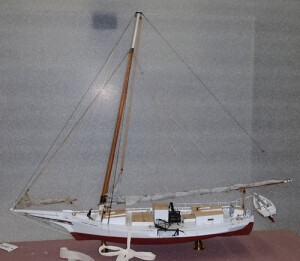 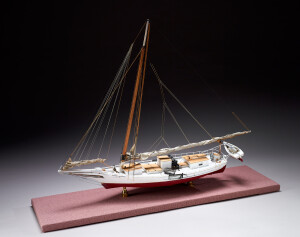 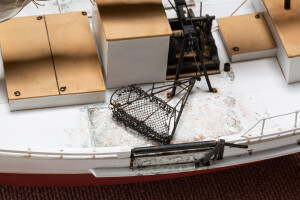 | MODEL DESCRIPTION: The model was built from a Model Shipways kit, with plans by Ben Lankford, Jr. Cast white-metal fittings furnished in the kit were replaced by scratchbuilt parts of excellent quality. Hull is maroon painted below the waterline, white above. Gilt eagle head figurehead, dark green trailboard and patriotic colors, emblems and name. Single mast with furled sail. Several deck housings. Oyster dredge and winch. Dinghy on stern on davits. This is an excellent model overall, with the furled sails conveying a particularly natural appearance, as ready for another trip to the oyster beds. Hull and deck are "weathered" to illustrate the effects of long, hard use. VESSEL INFORMATION- VESSEL NAME: WILLIE L. BENNETT ALL NAMES OF VESSEL: 1) WILLIE L. BENNETT NATIONALITY: AMERICAN HOME PORT: MARYLAND, CAMBRIDGE VESSEL TYPE: SKIPJACK (2-SAIL BATEAU) OFFICIAL NUMBER: HULL NUMBER: VESSEL DIMENSIONS: 42.6 X 14.3 X 3.4 FT (REGISTER) SERVICE DATES: 1899 - CA. 1978 SHIPBUILDER: SHIPBUILDER LOCATION: MARYLAND, INVERNESS ENGINE BUILDER: NONE ENGINE BUILDER LOCATION: N/A SHIP OWNERS: SHIP LINE OR OPERATOR: CAPTAINS OR OTHER RELATED PEOPLE: MAJOR EVENTS: VESSEL HISTORY: Abandoned, circa 1978 DATE SCRAPPED, WRECKED, ETC: PLACE OF SCRAPPING, WRECKING, ETC: ASSOCIATED (RELATED?) PLACES: RELATED VESSELS: (Identify each as sister ship, combatant, collision, etc.) LABEL COPY: Skipjack Willie L. Bennett (1899-1977) Model, scale 3/8"=1', 1981 Marvin L. Bryant, model maker Museum Collection 81.56 LABEL COPY: SKIPJACK The skipjack (or "two-sail bateau," as the waterman is more likely to call her) is the last working sailing vessel type in North America. A handful of skipjacks still dredge the oyster beds in Maryland, and several nattily painted examples turn up at regattas and other festivals every summer. The model shows the WILLIE L. BENNETT, a typical skipjack built at Iverness, Maryland, in 1899, as she appeared on the oyster beds. Her dredge gear and hand winders are ready for use, and her push boat hands from davits at her stern. Sailing oystermen rely on push boats to get them into port during a calm. Model by Marvin L. Bryant Scale: 3/8"=1' Collections of The Mariners Museum | CL13150 |
Created 2026 by Don Barker, CBMM volunteer, for the Chesapeake Shipbuilding Project. shipbuilding@sailingworkboats.es